


Scrivere di Arte ed Educazione all’Arte, di Miti e Fiabe, giardini e Natura, è acquisire ogni volta ulteriori pezzetti di universale Bellezza!
Anna Bruno’s blog
From the White Cube to the Feed: The Trap of Visibility in Contemporary Art Today
No Comments
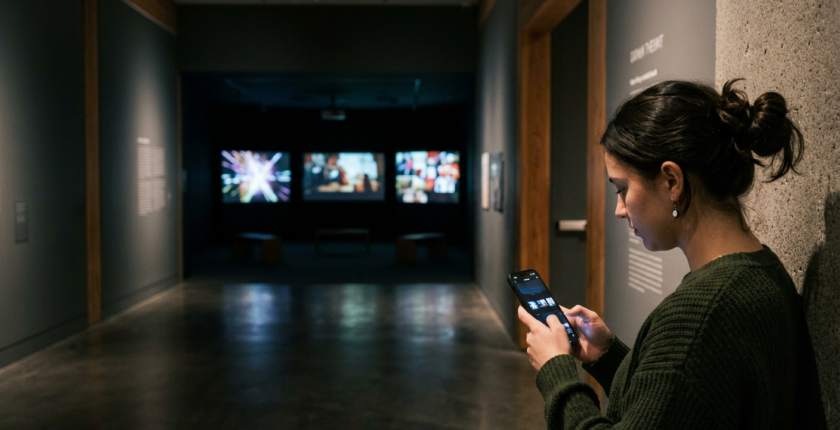
From escaping institutions in the 1990s to algorithmic performance anxiety: how the market has transformed contemporary art today, and why it is urgent to reclaim the right to invisible time.
As if moved by a sort of romantic claustrophobia, in the 1990s, artists crossed the solemn thresholds of institutional museums to return to the streets, among the people. And this to reclaim what has always been natural to them: territories of freedom in which to express themselves without constraints, thereby also restoring life and dignity to entire neighborhoods and to neglected places abandoned to themselves – transforming warehouses and social centers into laboratories of the future, just as happened in Rome with the experience of Metropoliz, il Museo dell’Altro e dell’Altrove (the Museum of the Other and the Elsewhere), and as still happens today in Librino, the most complex neighborhood in Catania, to which Antonio Presti, by involving local people, especially families and schools, has restored beauty and social redemption, founding the MAGMA open-air museum. And on this very path, Antonio Presti is the only one to hold the line in Italy.

Tired of being “too” managed, distant from the involvement of ordinary people for whom art was born, and sensing that it was losing its ancient mission, in those years artists decided to make their act of escape. The desire was to break free from the framework of a nineteenth-century style museum, by now crumpled in on itself – and therefore no longer capable of enhancing emerging creativity –, to seek a more vivid relationship with the world. Art wanted to be where life burned: in the neighborhoods, on the outskirts, in urban scars, on the ridges of hills, in the valley bottoms and, even, close to riverbeds, as happens with the monumental open-air works of the Fiumara d’Arte Foundation in Sicily, which also sprang from the subversive vision of Antonio Presti.
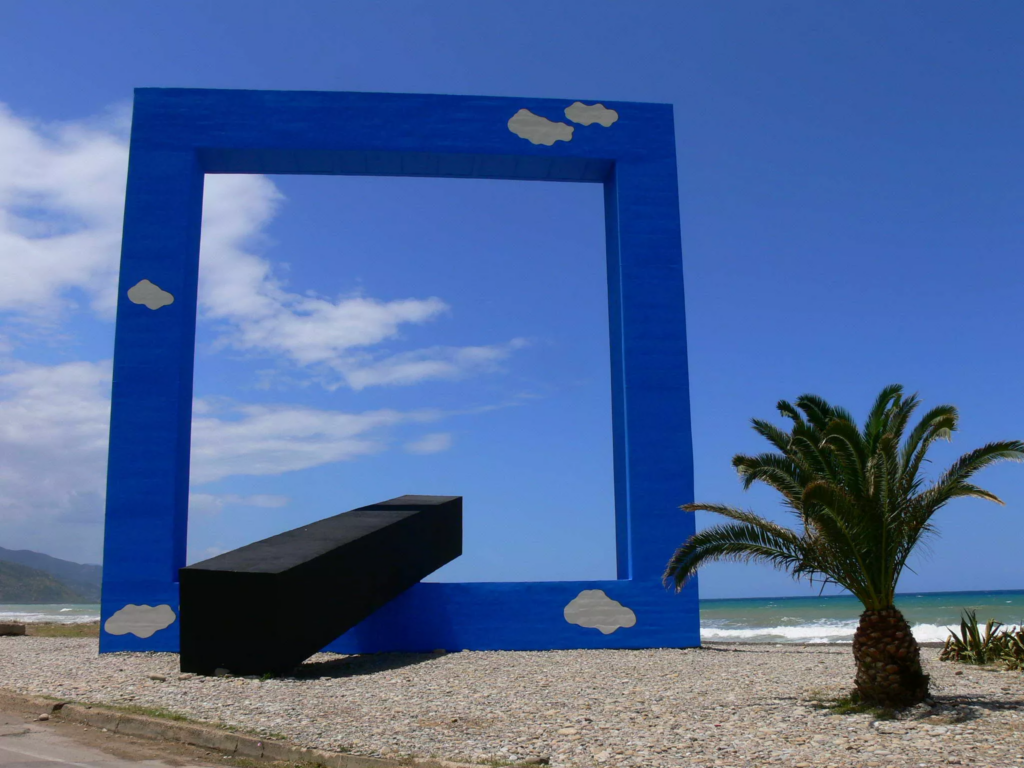 La finestra sul Mare (monumento ad un poeta morto) – Tano Festa (1989)
And for a while, it seemed to everyone that this rediscovered freedom – an inspiring regeneration of entire outlying neighborhoods abandoned to themselves – could last. That wherever it passed searching for a true, human, and spiritual contact, art would lead to rebirth and social dignity. In the meantime, however, the market did not just stand by and watch: it began to operate under the radar, careful not to make too much noise, slowly absorbing what lay outside of it. Galleries multiplied and began chasing urban interventions, while auction houses strategically harnessed street art, and collectors turned murals and graffiti into investment assets.
What had been born from an impulse of independence became, and not even that slowly, a new segment of the system. And the street entered the catalog. Then came Covid, like a crash.
Covid as a Watershed
With the pandemic, the doors of museums, galleries, foundations, and fairs slammed shut. The rituals that sustained the art system suddenly collapsed: openings, vernissages, previews, traveling from one biennial to another. The art community, used to recognizing itself in shared physical spaces, found itself confined within the rectangles of a screen. And even that romantic, energetic impulse of street art ended up normalizing, falling back into line.
Within a few weeks, everything moved online: exhibitions transformed into virtual rooms, auctions into live streams, talks into remote appointments. It seemed like a simple technical migration, but it was not. By changing the mediums, the hierarchies also radically changed: who decides what is seen, who has access to the works, and how an artist can make themselves known.

It is in this physical vacuum that the White Cube[1] definitively transformed into the Feed[2], the new global commercial showcase. The aseptic exhibition space of the gallery became a two-dimensional sequence of scrolling, overlapping, and disappearing images. It is a new and more subtle form of “capture” and commodification. Street Art itself, born to be experienced physically within the urban space, is today increasingly created or photographed for the sake of the Feed. It becomes purely “instagrammable” content, an ephemeral image that generates likes and engagement and, consequently, economic value for the market and auction houses.
More Independent, More Visible, More Alone
If in the 1990s independence meant leaving the museum to take to the streets, today it often means bypassing traditional mediation and speaking directly to one’s audience. Artists can show their work in progress, share their research, and build relationships without having to wait for an institution’s call anymore. In theory, it is a triumph: more opportunities, more access, more voices.
In practice, however, this freedom comes at a very high price. Artists – much like writers – are expected to simultaneously be authors, communicators, self-promoters, and strategists of their own visibility. The studio is no longer just the place of creation; it transforms into a backdrop, a set, a container of narratives ready for consumption.

From this springs a new and insidious form of prison: algorithmic performance anxiety. You have to be there always, updating, narrating, continuously proving that you are producing. Every silence feels like a disappearance; every creative pause becomes a fatal risk: if you don’t show yourself, do you still exist? Anxiety no longer concerns only the value of the artworks, but the very figure of the artist, constantly worn down by the fear of not being present enough, topical enough, “relevant” enough.
More Images, Less Value
While the number of images grows at a dizzying pace, the actual value of artistic work tends dramatically to shrink. On one hand, art is everywhere: shared, photographed, relaunched, and consumed within the span of a few seconds of scrolling. On the other hand, the majority of artists struggle to obtain adequate compensation for exhibitions, projects, and residencies; artworks remain stuck on consignment for a long time, prices are compressed, and negotiations become increasingly tight. The market polarizes ferociously: a tiny handful of “hot” names concentrate investments and attention on themselves, while a multitude of creators remain on the margins, despite continuing to produce uninterruptedly.
Value thus seems to shift from the artwork to the person, from research to the character: what truly matters are the biographical narrative, the public image, and the strategic positioning, far more than the intrinsic value of the artifact. Everything without a breath.
And within this gap, a double devaluation takes place. On one side is the economic devaluation, since the work is not remunerated proportionately to the time, costs, and intellectual commitment required; on the other is the symbolic one, because the artwork ends up being reduced to an indistinct fragment within a perpetually overloaded visual flow.
The artist thus lives a cruel contradiction: exposed and visible like never before in history, yet tragically invisible at the only point that truly matters – the recognition of the authentic value of their work.
Galleries and Solo Shows: From Recognition to Test
The role of galleries has also undergone a profound mutation. At the end of the 1990s, many realities built their choices over time, through well-structured group exhibitions and shared paths where the solo show represented the natural outcome of a relationship of trust, a fundamental milestone of mutual growth. Today, on the contrary, we witness frantic programming, marked by solo exhibitions set up at a continuous pace. Every exhibition thus becomes a disposable showcase, a ruthless testing ground: does it work or not? Does it sell or not? Does it generate articles and engagement?
 Homogenized Galleries – generated by AI for AnnaBrunoArtEducation
For the artist, this translates into the constant feeling of gambling their entire professional future in a few weeks, knowing that the continuity of the collaboration will depend on the market’s immediate response. What by its very nature should be a moment for the work to mature reverses into a high-tension exam: if the exhibition does not “perform” as expected, the artist’s name cools down and the path is abruptly interrupted. Even expressive language emerges compromised, forced toward easily recognizable, repeatable, and therefore saleable forms. The original promise of distinction – the solo show as a consecrated space dedicated to a unique voice – flips into its exact opposite: every creator “has” their solo show, but within a standardized format that tends to homogenize.
Museums, Brands, and Critical Spaces
Within the same post-pandemic scenario, museums and institutions also appear torn between two opposing vocations. On one hand, there is the push to transform into commercial brands: blockbuster events, an obsession with massive crowds, and setups designed to be quickly consumed through a smartphone lens. On the other hand, there endures the choice – more fragile, yet necessary – to become critical spaces: places of listening capable of confronting the social wounds that emerged during the crisis, working in contact with communities and local territories through slower, more stratified projects that are difficult to reduce to a two-dimensional image.
It is precisely between these two tensions that the return to the street takes place. Today, the urban dimension is no longer the romantic place of absolute freedom of the 1990s, but a space deeply scarred by precariousness, conflicts, surveillance, and ecological crisis. A harsh territory where art, if it truly wants to live up to the times, is called upon to measure itself against the vulnerabilities of reality, and not just its aesthetic surface.
New Powers and the Illusion of Autonomy
If once the center of gravity of power resided in institutions with a traceable face – museums, foundations, historic galleries –, today control has become molecular, diffuse, and invisible. Between the artist and the audience, it is no longer flesh-and-blood figures that move, but new and opaque intermediaries: algorithms of visibility, aggregated trend flows, and selection criteria devoid of a precise identity. It is no longer the calculated choice of a museum director that sanctions the existence of an artwork; what decides are the subterranean forces that regulate what deserves to float to the surface and what must be buried in digital oblivion. The artist thus finds themselves moving in an apparently boundless, yet dramatically unstable space, where every gesture is immediately exposed, consumed, and, with the same rapidity, forgotten.
Reclaiming the Invisible: For a Human Art
In this post-pandemic scenario, the exit from museums in the 1990s – which was a romantic and vital search for air – transforms today into a different and even more urgent necessity: the need to escape a silent suffocation, that of a permanent productivity that measures value only through the grid of immediate success. The true challenge is no longer played out in the dualism between street and museum, or between physical and digital. The stakes are radical and concern the right to rediscover a human time.
In a world that demands constant presence and the continuous exhibition of the self, the most revolutionary gesture then becomes the reclamation of a time stolen from the gaze: the slow time of thought, the dignity of the mistake, the fruitfulness of silent research.
It is only within that protected shadow zone, far from the imperative to please or to sell, that art can heal its wounds and return to being what it promised from its very origins: a sacred nostalgia for the desire to go beyond, an intimate space where man stops to listen to man. Only by restoring to creation the luxury of silence and fragility can art begin to look at the world again without casting its eyes down, offering to life, if only for an instant, a different possibility.