


Scrivere di Arte ed Educazione all’Arte, di Miti e Fiabe, giardini e Natura, è acquisire ogni volta ulteriori pezzetti di universale Bellezza!
Anna Bruno’s blog
Stefano De Santis’ fascinating exhibit in Rome: Lo sguardo e la materia (The Gaze and Materials)
No Comments

Appearing to have stepped out of the phantasmagorical realms of Don Quixote, the artist Stefano De Santis, much like Cervantes’ notorious hero, travels the world in the company of his creations, which were showcased last November at the Galleria Tibaldi in Trastevere, Rome.
Upon entering the gallery, one immediately feels distanced from the chatter and noise, sensing the urgency of the artworks to reveal their hidden mysteries to anyone seeking an intimate connection—an elective affinity. One by one, they begin to suggest a viaticum, a journey undertaken by the artist himself, which finds its starting point in the pictorial work Perspectives.
 Perspectives, oil on canvas, 2023)
Here, the artist paints a self-portrait viewed from above, so that the upper part of the canvas brings the most vulnerable part of the head—its crown—into the foreground. Yet, it is not the neurocranium that is offered to the viewer, but rather the central nervous system, the brain itself. This is the seat of thought and emotion, considered a sacred point perennially connected with the energies of the heavens and the external world—so much so that in antiquity, people covered it with veils to protect it from negative energies. De Santis scores the outline with pieces of rough wood, scratching the colors with intersecting, overlapping marks that strike out in every direction, evoking the frayed texture of a tattered dress. We cannot see his face, nor do we need to. His head is bowed, suggesting his eyes are fixed on his feet—bare and firmly planted on the ground—which become a symbol not only of connection to the earth but also of movement: a prelude, perhaps, to the subsequent figures the artist aptly named Pachyderms with no Memory.
 Pachyderms with no Memory, (terracotta, 2021)
Slow-moving terracotta sculptures present ethereal, elongated human figures riding headless equines, in a quiet effort to defy gravity and reach the heavens. They evoke the iconic forms of Modigliani and Giacometti, or perhaps Picasso’s Don Quixote, who likewise searches for the Absolute—a quest that, for our neo-Don Quixote, becomes equally obsessive.

The artist’s hands are immersed in the terracotta, manipulating it until they disappear—moving first into the hands of each pachyderm, then becoming part of its substance, or rather, a part of the Absolute. Any possibility of discerning the gender of the figures has also vanished, despite their nudity; they are sacred figures, weightless and ascending. The artist does not spare even the figures’ eyes: closed and undefined, they have already fulfilled their vision and now lose their purpose, giving way to that benevolent intruder, the third eye, so that the sinuous and sensual inner dances may begin and the process of liberation can be initiated.
From this point on, matter has no choice but to embrace its tormented alchemical metamorphosis, reminiscent of Michelangelo. This is the moment when the body (the matter-ego) allows itself to be shaped and freed from the superfluous—that which weighs it down and no longer serves a purpose—letting the Spirit direct the headless equine. And the Spirit is wind, and the wind blows where it wills. The equine, too, has lost its eyes and its very head; in their place is emptiness. In De Santis’s sculptures, voids and solids alternate in an endless play, driving this search for the Absolute.
 Gardian from above (painted terra cotta, 2025)
Meanwhile, led by the memoryless pachyderms, we reach the Guardian from Above, where the figure is seen stretching its arms upward, toward the immensity. The hands mysteriously reappear at the top, their palms curving downward, guarding whatever is in contact with the earth or within its womb. The feet, which once symbolized movement, now seem to have been swallowed up by Mother Earth; they are striking sacred roots. For the Earth is Mother and reclaims her children whenever she wills. And in the face of this calling, no one can escape.
 Kyklos (oil on canvas, 2023)
Looking at this slender, mystical sculpture, it evokes Kyklos, from the Greek word for circle: a human figure painted on canvas, now perceived as a silhouette, if not a simple circle. It has been stripped of everything: no eyes, no mouth, no nose, no ears. It is a pure silhouette that recalls the cycle of death and rebirth—a prelude to the subsequent sculpture, where a saddle appears without its rider.
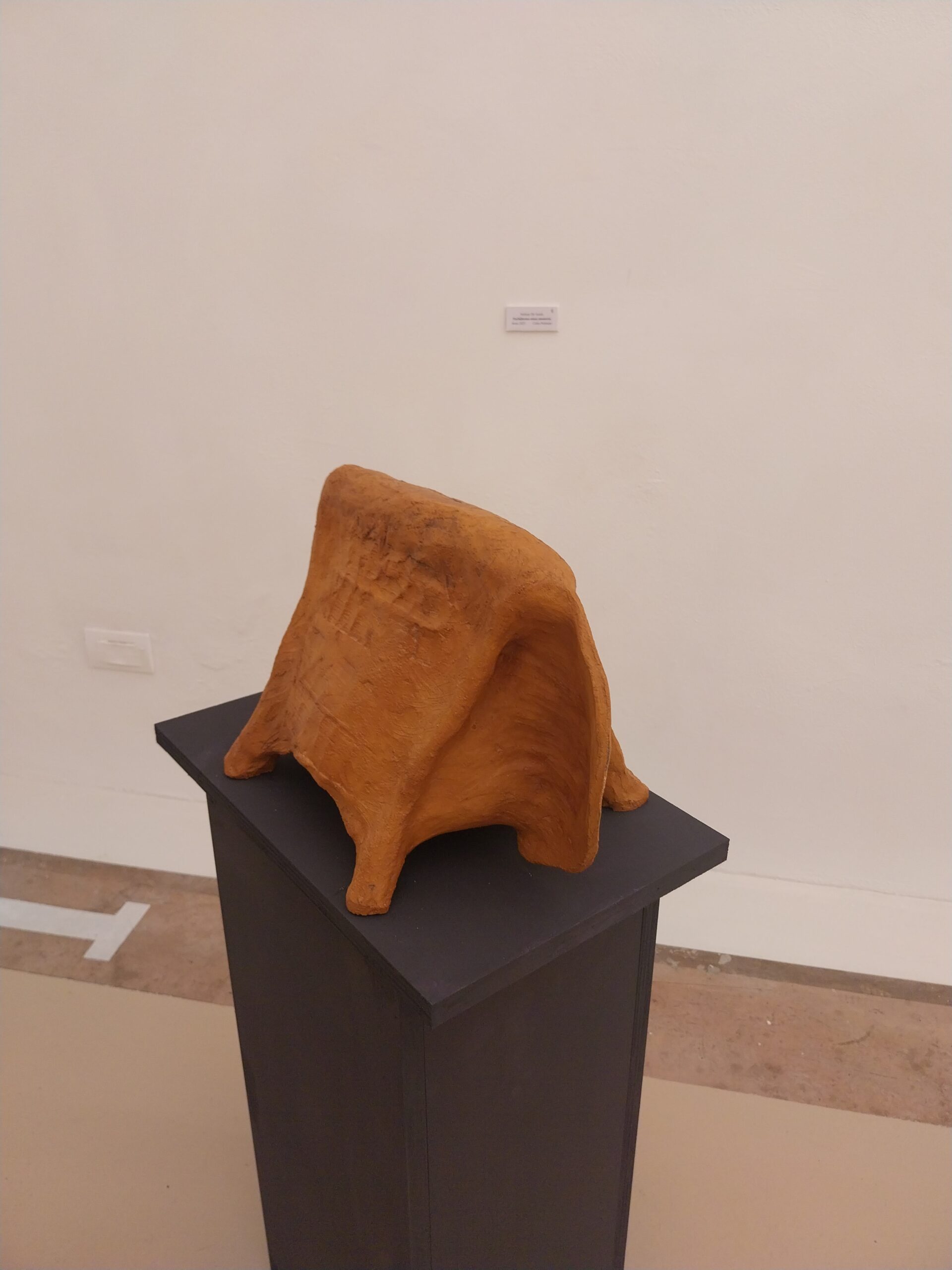 Pachiderm with no memory (series) (patinated terracotta, 2023)
Don Quixote has fallen from his horse, and upon contact with the ground (as we imagine), he is rendered invisible, undergoing an alchemical transformation. From here on, the figures certainly reappear, but their bodies are now cast in bronze, their feet definitively amalgamated with matter; their heads, gazes, and noses point upward as they, too, become lost in the universe. One thing is certain: they will once again feel like dust within the Great Perfection.
Suspended between Heaven and Earth (detail, bronze – casting, 2025)
The final bronze sculpture, Suspended between Heaven and Earth, a bronze casting dated 2025, is animated by birds flying around it.
 Suspended between Heaven and Earth (detail, bronze – casting, 2025)
A little bird enters the space created by the artist in the upper part of the back and, as though rapt, is about to reach the innermost part, the pulsating center of every human being, capable of beating unrestrained at the call of unconditional love: the heart. The bird is not required to understand, nor to see in order to find its way: it is enough to feel in unison with this precious and uncontrollable organ even before arriving. Here, the artist’s viaticum reveals his mission, while De Santis-Don Quixote is already imbued with the essence of life.
This is an essence that can be savored in his Japanese gardens, where Yin and Yang have found a way to overcome irreversible conflicts, rediscovering the embrace of balance within themselves and with the entire universe. For the artist Stefano De Santis is also a gardener, and as I write in my text Anima Persa Anima Ritrovata: periegesi intorno ai giardini vaticani (Palombi Editori, Rome 2017): ‘…God brings man into his garden, forcing him to confront the loss of the self, because loss is not a lack, an absence, but is instead an indispensable stage in its continuation: we lose ourselves in order to find ourselves and, once again, originate.‘ (pp. 24-25).“
Stefano De Santis was born in Rome’s Garbatella district on May 28, 1961. He began his self-taught artistic career in 1977, and in 1982 met De Angelis, who introduced him to the world of sculpture.
He has exhibited his work in numerous galleries throughout Italy, participating in prestigious exhibitions such as the ‘Festival dei Due Mondi’ in Spoleto, the Quadriennale in Rome, ‘Work in Progress’ in Via Margutta (Rome), and at the Palazzo Piccolomini in Pienza.
In 1997, Alberto Lescay of the Fundación Caguayo invited him to take part in a series of exhibitions and masterclasses at his workshop in Santiago de Cuba. This period marked the beginning of his collaboration with Cuban artists, including Alexander Lobaina Jimenez, through whom he expanded his practice into collagraphy, a graphic printing technique. While in Cuba, De Santis held a solo exhibition entitled Ochosi at the Modern Art Gallery in Santiago. In Havana, he frequented the studios of Nelson Domínguez and many other prominent local artists. His work was showcased across various ‘Cultural Houses’ in Havana, Alamar, Villa Clara, and Caibarién, as well as at the Book Museum (Palacio del Segundo Cabo) in Old Havana in December 1997. In 1998, he held a solo exhibition featuring unique Central and South American glass works at the Municipal Museum, followed by an exhibition in Santa Clara in October of the same year.
Upon his return to Italy, he came into contact with the creative community of Corviale in Rome in 2008 and began collaborating with Comunità X. In 2020, he joined C. Chierici, G. Ceraldi, and G. Savino in ‘Virus’—an artistic collective originally founded in Naples in 1984 and re-formed in Rome in 2020. His work has also been exhibited in L’Aquila, at the Pinacoteca D’Arte Sacra di Sant’Elia, which houses one of his satin-finished bronze bas-reliefs. His recent exhibitions include the Galleria Antonio Neiwiller in Rome (2020–21); the Drugstore Museum in Rome (2022–23), as part of the archaeology and public works exhibition ‘Napoli New York Corviale’ organized by the Special Superintendency of Rome; the BACC Gallery in Via Panisperna / Studio Tibaldi (2023–24) with a solo show titled Corporeus; and the Oxford Hotel (2024–25) within the group exhibition Kontemporanea Art On Time – Tutto è Arte.“
Stefano De Santis currently lives and works in Rome.
The exhibition Lo sguardo e la materia was held at Galleria Tibaldi Arte Contemporanea, in Via Panfilo Castaldi 18, in November 2025.