


Scrivere di Arte ed Educazione all’Arte, di Miti e Fiabe, giardini e Natura, è acquisire ogni volta ulteriori pezzetti di universale Bellezza!
Anna Bruno’s blog
Between East and West: When Art Becomes a Bridge Between the Soul and the Earth
No Comments
It is with great pleasure that I share with you my new publication, featured in the pages of Parresìa Cultura (https://parresiacultura.it/)
In this article, I wanted to explore a movement that has always fascinated and questioned our culture: the constant gaze that the West turns toward the Levant, in search of an ancient purity, silence, and spirituality. A calling that finds its natural bridge in art—made of icons, sacred architecture, chants, and spaces woven with emptiness.
Yet what happens when this desire for the absolute meets our modern world, so often dominated by the logic of consumption and materialism? Today more than ever, the risk is turning a profound quest into a mere design object or a pre-packaged experience.
To better understand this tension between spirit and matter, my journey stops in a special place: 6th- and 7th-century Calabria. A land of borders and encounters that, over the centuries, became a true laboratory of spirituality, where the legacy of the Basilian monks and the influences of the Levant permanently reshaped the dialogue between the two shores of the Mediterranean.
I invite you to read the full Italian article on https://parresiacultura.it/ Issue No. 3 has just been published and is available right on the homepage (my article is the fourth one, on page 18). Here I am sharing the magazine directly with you: https://www.periegeta.com/wp-content/uploads/2026/11/Parresia-numero-3-compresso_261115_170111.pdf (p. 18), to discover how the beauty of the East continues to speak to us and challenge us today. The other articles by various scholars are equally fascinating.
Hereunder my translation of the article:
Between East and West: When Art Becomes a Bridge Between the Soul and the Earth
Since time immemorial, the West has leaned toward the Levant like someone gazing into the dark in search of a lost soul; it does so chasing the scent of an ancient dawn and a forgotten purity. It is not the discovery of a new land, but a return to a part of itself left behind.
Thus, every few decades, obeying the call of this eternal nostalgia, our culture questions the silence of Buddhism, the grace woven from emptiness in Japanese aesthetics, and the golden reflections of Byzantine wisdom, only to let itself be cradled by tales fragrant with sand and spices, gardens suspended in the sky, and deserts that taste of infinity. And it is almost always art that becomes the bridge: an invisible tapestry of icons, sacred architecture, and chants promising a gentler way of inhabiting the ea
Yet, inevitably, this call to the absolute fades away among market shelves and the shop windows of wellness temples, commodified in the design of a lamp claiming to be “Zen” or in the pre-packaged illusion of an “Arabian Nights” journey. What was born as a path of the spirit is sucked into the vortex of profit. In this article, we will trace the steps of this tension: we will recount how Eastern beauty has fertilized the Western imagination and why our culture, though seduced by the sacred, always ends up imprisoning it in matter. Our journey finds its center of gravity in 6th- and 7th-century Calabria: a laboratory of spirituality, where the echo of Basilian monks and the myths of the Levant merge with an even more ancient heritage, forever redefining the boundaries between the two shores of the Mediterranean.
The Roots: The East as a Silent Presence (Calabria, 6th–8th Century)
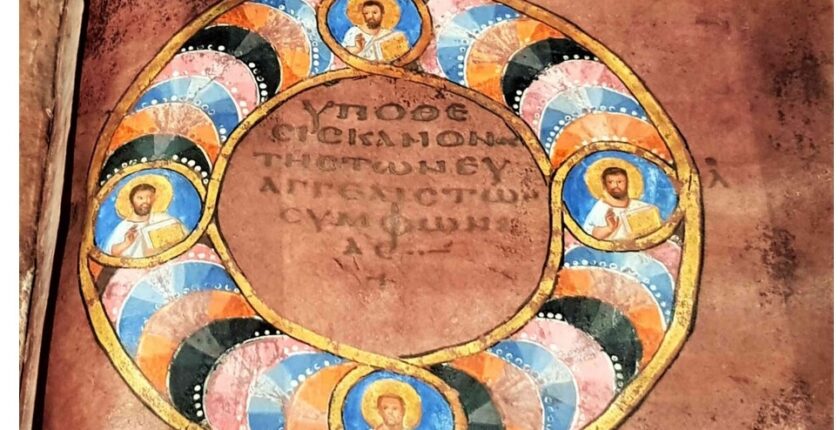
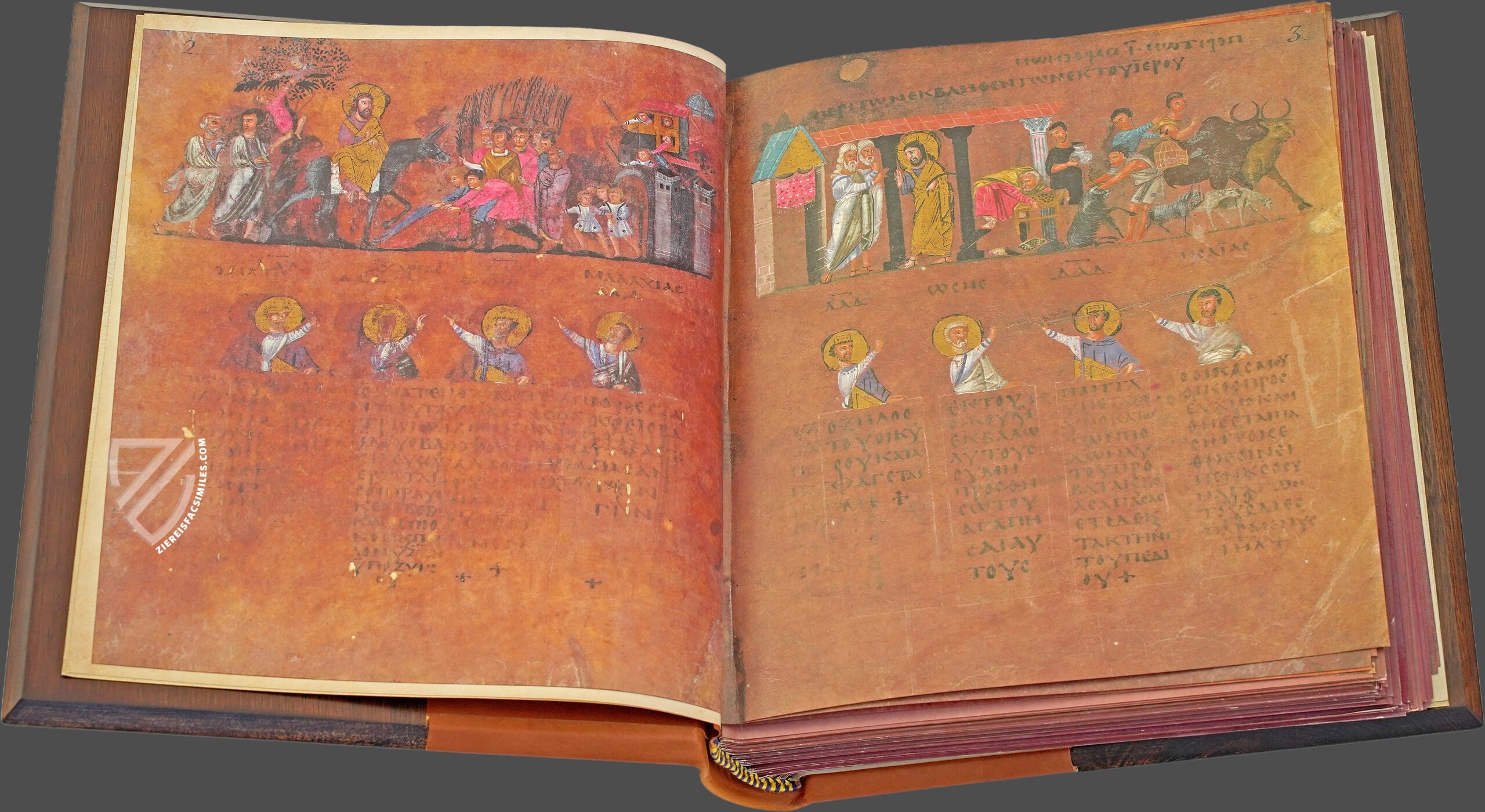
Between the 6th and 8th centuries, the Mediterranean was not a border that separated, but a hinge that united. Along its routes traveled not only fabrics and spices: people, manuscripts, icons, and fragments of prayer traveled as well. Thus it was that onto the shores of Southern Italy—and among the folds of the land of Calabria in particular, where the Abbey of Santa Maria del Patire in Corigliano-Rossano still stands tall as a monument to that encounter—landed royal highnesses, monks, and hermits, custodians of the Basilian tradition. They brought with them illuminated manuscripts, such as the wondrous Codex Purpureus Rossanensis, whose purple-tinted pages seem to hold the very light of the empire; icons that wove together color and silence, modeled after the Madonna dell’Achiropita—also in the Cathedral of Rossano—an image not painted by human hand, but sprung from mystery; and ascetic practices born in the Greek and Syriac East. The imprints of this passage still vibrate today in sanctuaries of stone: hermit caves, small rock-cut oratories, and forgotten monasteries, scattered between the solitudes of the Aspromonte and the light of the Ionian coast.
The Other Face of the Sacred: The Breath of Myth and the Arabian Nights
However, this Eastern lifeblood does not flow solely through the channels of biblical codices or among the austere forms of worship. Alongside sacred texts and mysticism, there are humbler, subterranean currents: legends and folktales that travel amidst the dust of caravans to become an evening whisper. The emblem of this river is the mosaic of the One Thousand and One Nights, a warp of Persian, Indian, and Arabic threads where dream dialogues with reality. Much like Christian icons, these tales still train the gaze today to discern the miracle within the everyday: they are keys forged to cross a threshold.
When the West stumbled upon them, it remained bewitched; thus, the East penetrated its artistic veins through the myth of caliphs, deserts, and invisible cities. Yet, even in this realm, the inexorable pattern of consumption repeats itself: what was once a vehicle of wisdom is reduced to mere ornament. The initiatory core of the fairy tale slowly dissolves, leaving in its place nothing more than a surface atmosphere, a postcard arabesque.
Transition: From Silent Roots to the Modern Wave of Orientalism
For centuries, this fertilization took place under the sign of a silent, almost invisible presence. Whoever opened a purple codex in Rossano or listened to the fragment of a Syrian fable among the stalls of a port was not looking for “the exotic”: they were looking for God, or for themselves, for the divine within themselves. The East was not a geographical elsewhere to be studied or collected, but an inner dimension speaking the universal language of mystery and symbol.
Between the 18th and 19th centuries, however, a silent yet radical rift occurred. The fissure in the visible, which ancient art had painstakingly opened, began to close again. The dialogue, previously woven from silence and asceticism, transformed almost d’emblée into a posture of the Western gaze: thus Orientalism was born. The East of the world ceased to be a subterranean spring of wisdom and transformed into a grand stage for Europe’s desires and projections.
It was no longer the time of Basilian monks fusing color with prayer. It was the era of cultured travelers, academic painters, archaeologists, and poets leaning toward the Levant to capture its lights, vestiges, and mysteries. In this scenario of visual conquest, only the first generation of the Pre-Raphaelite Brotherhood seemed to grasp and guard the secret soul of that world. Rejecting the coldness of modernity, artists like Dante G. Rossetti and William H. Hunt, John E. Millais, and a few others alongside them, turned to the East not to plunder it, but to rediscover lost sacrality: their paintings were populated with Byzantine golds, precious fabrics, and hieratic gazes, transforming the canvas into a new icon where mystery could still dwell.
The rest of the West, instead, now firmly clinging to the primacy of matter, technique, and production, began to look at those distant lands with a dual soul: on one hand, the craving for possession and cataloging; on the other, a poignant nostalgia for a sacred it felt it had lost in the fumes of its own Industrial Revolution.
In this transition, art underwent a crucial metamorphosis. The sacred image and the myth, which were born to be experienced as journeys of the spirit, began to be translated into the language of pure aesthetics. The modern wave of Orientalism invaded European canvases, salons, and literatures, yet it carried within itself the seed of a great misunderstanding: mistaking the surface for the core, the scent of spices for the wisdom of the desert, the ornament for the path. That wave, which seemed to want to bring the two worlds closer together, actually laid the foundations for the definitive transformation of the East into a splendid, exorbitantly expensive commodity for the gaze.
19th Century: Orientalism Between Fascination and Projection
Over the course of the 19th century, the East transformed for Europe into a space of the soul, even before becoming a geographical coordinate. While the Brotherhood sought its lost sacrality, on the canvases of academic Orientalism there bloomed instead harems suspended in time, dazzling deserts, and markets teeming with life. Too often, this painted Levant was nothing more than a mirror: a lavish exotic stage set created by the West to project its own unconfessed desires, rather than to weave an authentic dialogue with otherness.
Yet, even through the mesh of these distorted representations, a splinter of truth managed to filter through. Almost clandestinely, a different way of conceiving the passage of time, the sacrality of the body, and the substance of the spirit slipped past; a changed relationship between the fragment of the individual and the immensity of the cosmos shone through.
Thus, the very same duplicity that had marked the history of icons and fairy tales repeated itself. On one hand pulsed the authentic need to draw from a distant spring, since the rivers of the West now appeared parched; on the other, the fatal temptation imposed itself to defuse that quest, reducing it to mere style, a parlor trend, pure aesthetic surface.
From Japan to Abstraction: The Western Gaze Changes Shape
A decisive turning point occurred between the end of the 19th century and the dawn of the 20th, when European ports were flooded with ukiyo-e, the Japanese prints of the “floating world.” Faced with sheets so distant from academic canons, masters such as Monet, Van Gogh, and Degas were struck as if by lightning. In them, they discovered the vertigo of an essential line, the audacity of asymmetrical framing, and, above all, the revelation of emptiness understood as an active part of the visible. Through the Far East, a revolution of the gaze thus penetrated: representation emancipated itself from the obligation to copy reality, becoming synthesis and suggestion.
At this point of contact, a fundamental philosophical discrepancy emerges. For Eastern thought, emptiness is not an absence, but a potential space in which form breathes; conversely, the Western soul historically identifies value with fullness and accumulation, feeling the urge to fill the surface of the canvas and the very flow of time.
Abstract art and the minimalisms of the 20th century represent the attempt to rediscover the sacrality of this emptiness. Surfaces reduced to the essential and absolute geometries become the conduits of a quest that dialogues with Zen aesthetics. It is the very same breath that inhabits the stillness of stone gardens or the calligraphic gesture: the attempt to make art no longer a celebration of matter, but the trace of a divine absence.
20th Century: Zen, Meditation, and Artistic Avant-Gardes
In the heart of the 20th century, contact with the East took a radical leap: what traveled were no longer styles, but the very practices of the spirit, from yoga to Sufism. Many artists were fascinated by a dazzling intuition: art understood as process rather than object, as pure presence rather than representation.
In this cultural climate, performance art, Land art, and contemporary music converged toward an Eastern conception of the creative act as a path and discipline. The work resides in the very gesture that generates it; the quality of attention takes center stage, and the barrier between artist and spectator dissolves into the womb of a shared ritual.
The avant-gardes thus mirrored themselves in millennial practices such as the way of tea or calligraphy. In these universes, although form retains its beauty, the true center of gravity remains mental presence, the sacrality of movement, and the rediscovered unity between body and spirit.
The Contemporary Paradox: Spirituality for Sale
Just as this dialogue reaches its peak, the Western paradox manifests itself: the ability to convert everything into a product. Millennial practices and aesthetics of silence are emptied of their original core to be recast into design brands, wellness packages, and decorative fetishes. Even art born to give form to interiority ends up populating luxury galleries as a refined status symbol. What was conceived as a path to extinguish the ego thus flips into its exact opposite: a tool to feed it, definitively bent to the logic of the market.
Why Does the West Always Return to the Material?
Behind these cycles lie the structural traits of our culture. First among them is the centrality of the proprietary self: in the West, possession also applies to inner states, transforming spirituality into a trophy to be displayed. The definitive rift lies in the difference between practicing wisdom and consuming its image. While Eastern traditions demand a radical transformation of living, the Western soul prefers to settle for the aesthetics of that transformation: a reassuring symbol, a design object, an ephemeral experience that runs aground on the surface.
Toward a True Dialogue Between Art and Spirituality
Faced with this drift, the challenge lies in inhabiting the embrace with the East with a radically different posture. We must choose depth over decoration, ceasing to view the Levant as a warehouse of symbols to be plundered and rediscovering it as a living interlocutor. This requires returning to art as a path rather than a product: rediscovering painting, dance, or writing as inner exercises, where the process matters as much as the result. Only then does the dialogue become authentic, cracking the certainties of a Western culture forever obsessed with fullness and acceleration.
Thus: Buying Spirituality or Beginning to Live It?
From the stone solitudes of Basilian monks in Calabria to Japanese prints, passing through the gold of icons, the swirls of the One Thousand and One Nights, and contemporary minimalisms, the East has continuously offered the West the very same opportunity: to tear through the veil of matter to rethink the spirit. Today, the real question is deciding what to do with this legacy: whether to continue reducing it to a sophisticated aesthetic frame for our materialism, or to allow it to work deeply, like a seed in the earth. Art remains the last territory in which this choice becomes visible, oscillating between the fate of a luxury shop window and the promise of a threshold thrown wide open onto the infinite.