Elio Rumma: the sign that becomes visual jazz and silent polyrhythm
Welcome to the polyphonic and universal universe of Elio Rumma
Elio Rumma
visual artist, publisher, filmmaker, musician
Rhythmic and shamanic,
Elio Rumma crosses wood and desert as alphabets:
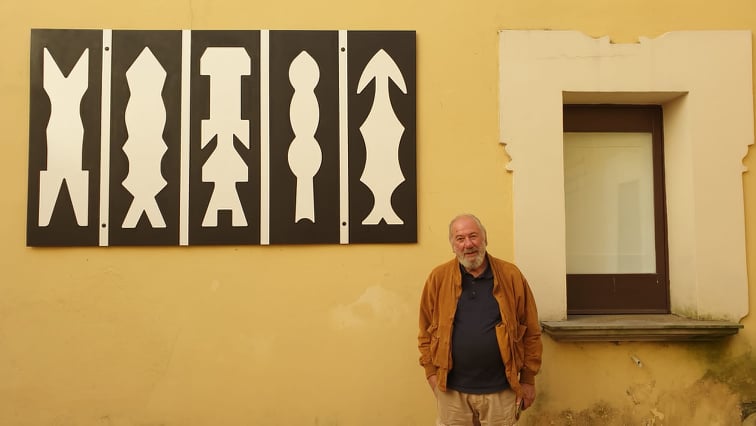
lightweight silhouettes, dancing symbols, full and empty spaces alternating
in a silent polyrhythm between Earth and the Heavens, in search of Essence.

My curatorial statement
Void, absence, yet essence, where figures – anthropomorphic, phytomorphic, zoomorphic – wander like metaphysical signs arrived from some unknown place already crossed by fire. Rumma‘s figures are weightless, as if they had burned away the superfluous to return to archetypes. There is something of jazz in this process: improvisation, offbeat, a silent polyrhythm that guides the composition.
On his panels and canvases, often like strips of desert inscribed within alchemical circles and squares, the silhouettes arrange themselves without hierarchies, each with its own breath, yet in resonance with the others. It is not so much the individual figure that counts, but rather their being together: constellations of signs seeking a universal language between Heaven and Earth.
Through a cultural bridge stretched between the peaks of the Himalaya and the mysticism of Brazil, Rumma translates lightweight matter and sacred geometry into a symphony of ancestral symbols, redefining the boundary between the visible and the invisible.
The artist’s research
The central theme of his research is the exploration of the void as a profound essence, a dimension where the sign becomes a spiritual archetype purified by fire
My gaze
Why did I say yes to this artist?
Because in Elio Rumma I recognized a rare consistency between life and visual language. His biography—publisher, exhibition organizer, co-founder of the Filmstudio, traveler between the Himalaya and Brazil, man of cinema and music—does not remain in the background: it condenses into the weightlessness of his signs, his colored deserts, his symbols carved in balsa wood.
Looking at his works, I felt that every silhouette was a question posed to the void, and every void a silent answer: an invitation to dwell in that visual Rigpa where mind and image coincide. Writing about him, I realized that his void is, in fact, filled with presences.
In the dialogue born around my text, the artist himself recognized something of his own essence: as if those words had helped restore the deep thread of his research back to him, without the need to persist or over-explain, but through pure resonance.
The artist in brief
Elio Rumma (Salerno, 1946) has always combined visual arts, philosophy, cinema, and music. In 1967, alongside his brother Marcello, he founded Rumma Editore, shaping crucial seasons for the Italian avant-garde, such as the historic Arte Povera exhibition in Amalfi in 1968.
He subsequently dedicated himself to musical experimentation (jazz and rock) and directing, filmmaking documentaries for RAI and collaborating with masters such as the Bertolucci brothers, Scola, and Pontecorvo. In 1972, he was among the co-founders of the renowned Filmstudio in Trastevere, Rome.
His research is fueled by long periods abroad: five years in the Himalaya and twenty in Brazil, where he assimilated Tibetan Bon spirituality and Candomblé cults. From these cultures, he draws a shamanic vision centered on the study of the void, the sign, and pure awareness (Rigpa).
In his works, acrylic meets symbols carved in balsa wood—a material of extreme weightlessness that becomes a metaphor for a perfect balance between matter and spirit.
About the exhibition at Angri (Sa)
Elio Rumma‘s solo exhibition “Assenza / Essenza / Rigpa”, curated by Anna Bruno, brought together works in which the artist intertwines his experiences in the Himalaya and Brazil with a rigorous research into the sign, the silhouette, and the void as an inhabited space. It was held from March 5 to April 5, 2026, at the Pagea Arte Contemporanea Gallery, via Concilio 99, Angri (SA).
Introduction to my article about the artist
In the article “At the personal ‘new Flatland’ of artist Elio Rumma ‘Assenza/Essenza/Rigpa’, curated by Anna Bruno“, this journey is explored in greater depth, focusing on references to Tibetan Bön, Afro-Brazilian cults, and the notion of Rigpa as a key to interpreting the work. You can read the full translation notes and details.
Elio Rumma’s current solo exhibition – a new “Flatland”- : Absence Essence/Rigpa. Curator Anna Bruno